
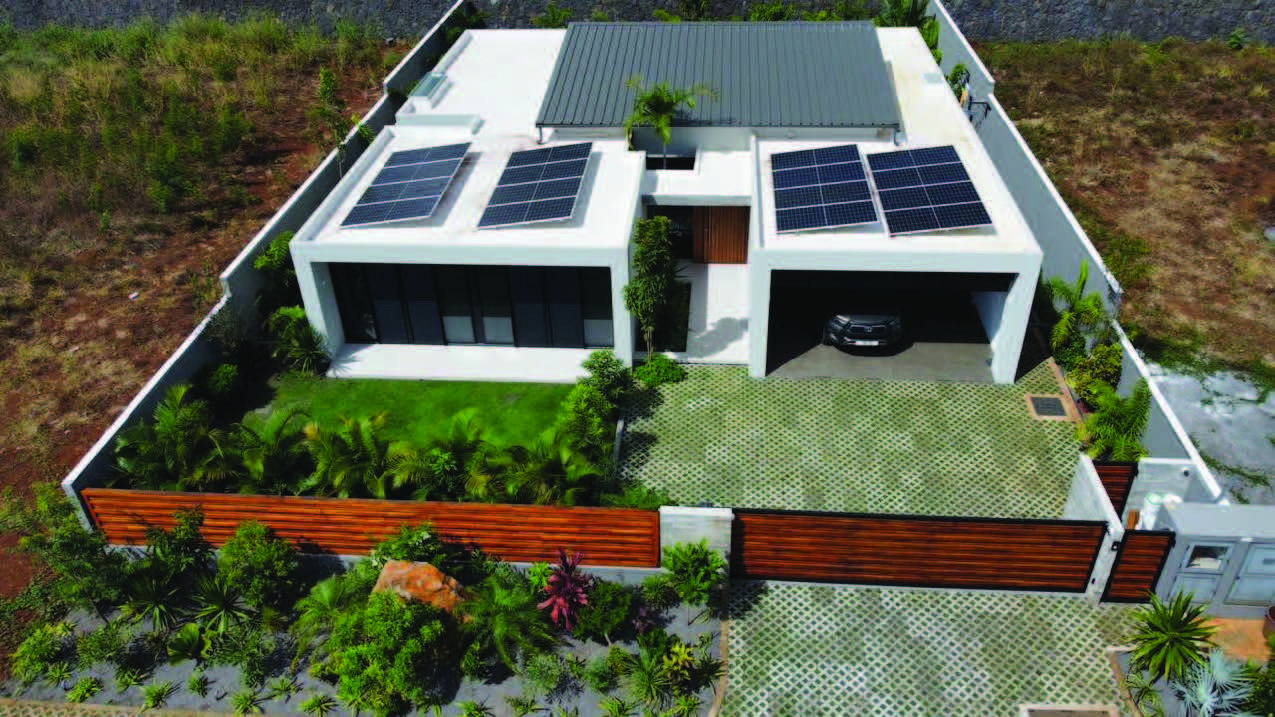
Solar panels, a hybrid inverter and a battery, still connected to the CEB — the system that lowers the bill and keeps the lights on when the grid goes down.
A hybrid solar system is a photovoltaic installation that keeps its grid connection and adds storage behind a single inverter that can manage both. It is the middle path between a plain grid-tied system, which stops the moment the CEB supply does, and a fully off-grid system, which cuts the connection altogether.
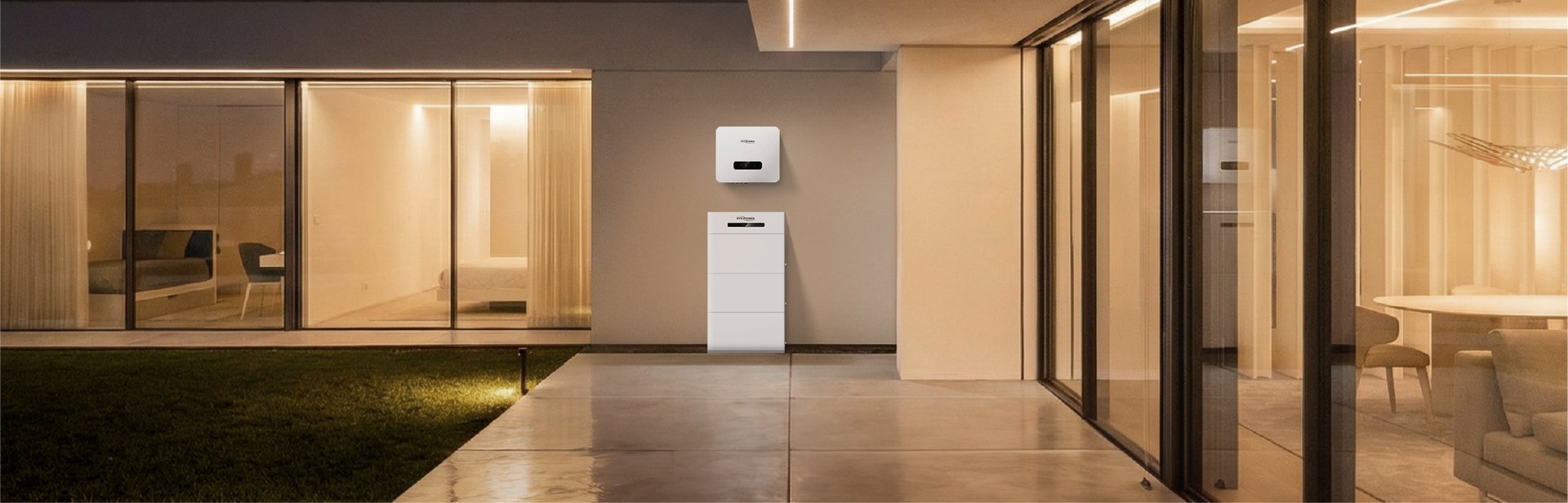
The word that matters is hybrid inverter. An ordinary grid-tied inverter has one job: turn the panels' DC into AC and push it into the house. A hybrid inverter has four — it does that, it charges and discharges a battery, it decides moment by moment whether the cheapest available energy is the sun, the battery or the grid, and it can disconnect from the grid and run your circuits on its own.
For most Mauritian homes and small businesses this is the right default. You keep the grid as a backstop for the week of bad weather you will inevitably get, you stop exporting your midday surplus for less than you buy it back for, and you stop losing the contents of the fridge every time the supply drops.
It is also the configuration that grows well. Add panels later and the inverter takes them. Add a second battery and the stack takes it. The one decision that is hard to reverse is the inverter itself, which is why we size it for where the system is going rather than where it starts.
Chosen circuits keep running through a CEB outage.
Evening load runs on the day's own generation.
No need to over-size for a run of bad weather.
Panels and battery packs can both be added later.
Almost every solar enquiry in Mauritius is really a choice between these three. They are not tiers of quality — they answer different questions, and the cheapest one is not always the right one.
| Grid-tied | Hybrid | Off-grid | |
|---|---|---|---|
| Battery | None | Yes | Yes, large |
| CEB connection | Required | Kept | None |
| Works in an outage | No | Yes | Not applicable |
| Best for | Lowest cost per kWh saved | Homes and businesses on the grid | Sites the grid does not reach |
If the grid already reaches you and you simply want the bill down, grid-tied is the cheapest route. If you want the bill down and you are tired of outages, hybrid is the answer. Only cut the connection when there is no connection worth keeping — which is a real situation in parts of Mauritius, and the subject of our off-grid page.
The inverter detects the loss of grid voltage within milliseconds and opens its grid contactor — a legal requirement, so no power is pushed back onto lines someone may be working on.
The backup circuits are re-energised from the battery. On a well-configured system the changeover is fast enough that lights do not visibly blink.
If the sun is up, the panels carry on charging the battery and feeding the house — which is why a hybrid system outlasts a generator's fuel tank in a long outage.
When the CEB supply returns and stays stable, the inverter matches phase and closes back onto the grid without interrupting the house.
Nothing in a hybrid solar system is exotic. What makes one work better than another is whether the five pieces were specified together — an inverter that suits the battery, a battery that suits the load, and protection sized for the array actually on the roof.
It depends on what you are buying. Measured purely as rupees saved per rupee spent, a grid-tied system wins — the battery is the expensive part and it does not generate anything. Measured as a household that keeps running through an outage and uses its own evening power instead of buying it back, hybrid wins comfortably. Most of our residential customers choose hybrid, and almost none of them regret it during cyclone season.
Yes, provided the inverter you install now is a hybrid one. That is the whole trick: a hybrid inverter runs perfectly well with no battery attached, so you can commission the array first and add storage when it suits you. Install a plain grid-tied inverter instead and adding a battery later means either replacing it or bolting on a second AC-coupled system.
Yes. Any system that stays connected to the grid needs the grid connection agreed, and we handle that paperwork as part of the installation — it is included in our EPC scope, not billed as an extra.
Less than people expect, if you are honest about which circuits matter. Lights, fridge, Wi-Fi, sockets and fans for a night is a modest load. Air conditioning and an electric water heater through the same night is a much larger one. We agree the backup circuit list before quoting, because it changes the battery more than any other single decision. There is more on sizing on our solar batteries page.
It can, but that is a design decision with a price attached rather than something to assume. An inverter-type split unit drawing around 1 kW for six hours needs roughly 6 kWh of usable storage for that appliance alone. If night-time cooling is the goal, say so early and we will size for it.
Start with the calculator for a size and a cost, or talk to us and we will work from your CEB bills instead.