
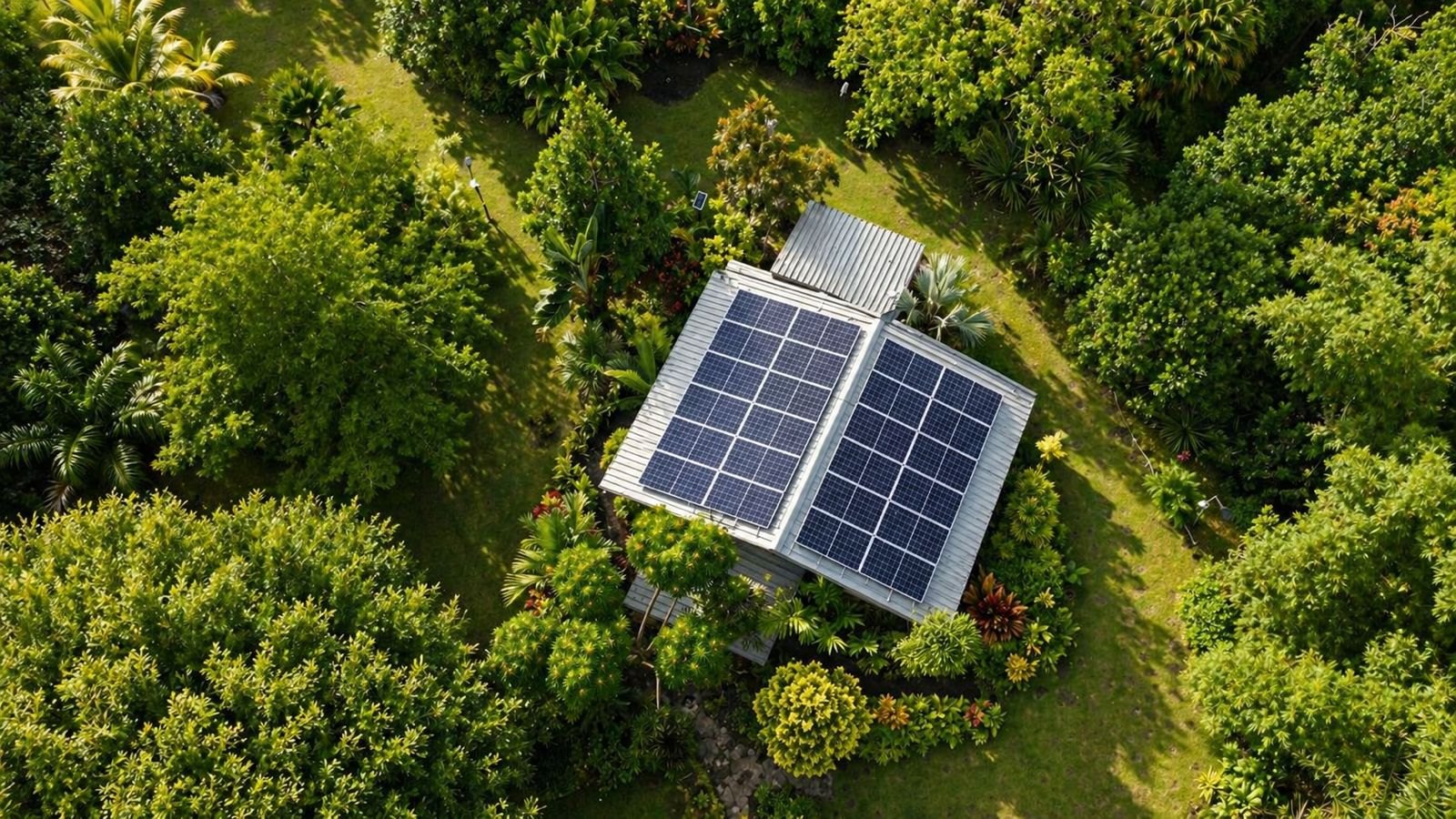
No CEB meter, no monthly bill, no connection to lose — systems sized to carry a building through the rainy season on sun and storage alone.
Off-grid solar energy means there is no utility connection at all. The building makes every kilowatt-hour it consumes, stores what it does not use immediately, and has nothing to fall back on when it runs short. That last clause is the whole engineering problem, and it is what separates an off-grid system from a large hybrid one.
A grid-connected system can be sized for the average day, because the grid quietly covers the difference on the bad ones. An off-grid system has to be sized for the bad ones. In Mauritius that means the rainy season — a run of overcast days in which a roof might deliver a fraction of its usual yield, with no meter to borrow from.
Done properly, the result is genuine independence: no bill, no outages, no tariff revision to absorb. Done casually, the result is a beautiful array and a house that runs out of power in February. We have been building these in Mauritius since 2013, and the difference is almost entirely in the sizing.
Off-grid is the right answer when the grid is not there, when bringing it in costs more than generating your own, or when independence is itself the point. It is rarely the cheapest way to reduce an existing electricity bill — if you already have a meter and simply want it smaller, a hybrid system will almost always cost less for the same saving. We would rather say that up front than sell the bigger system.
Nothing to pay, and no tariff revision to absorb.
Remote sites become viable without a line extension.
There is no supply to lose in a cyclone.
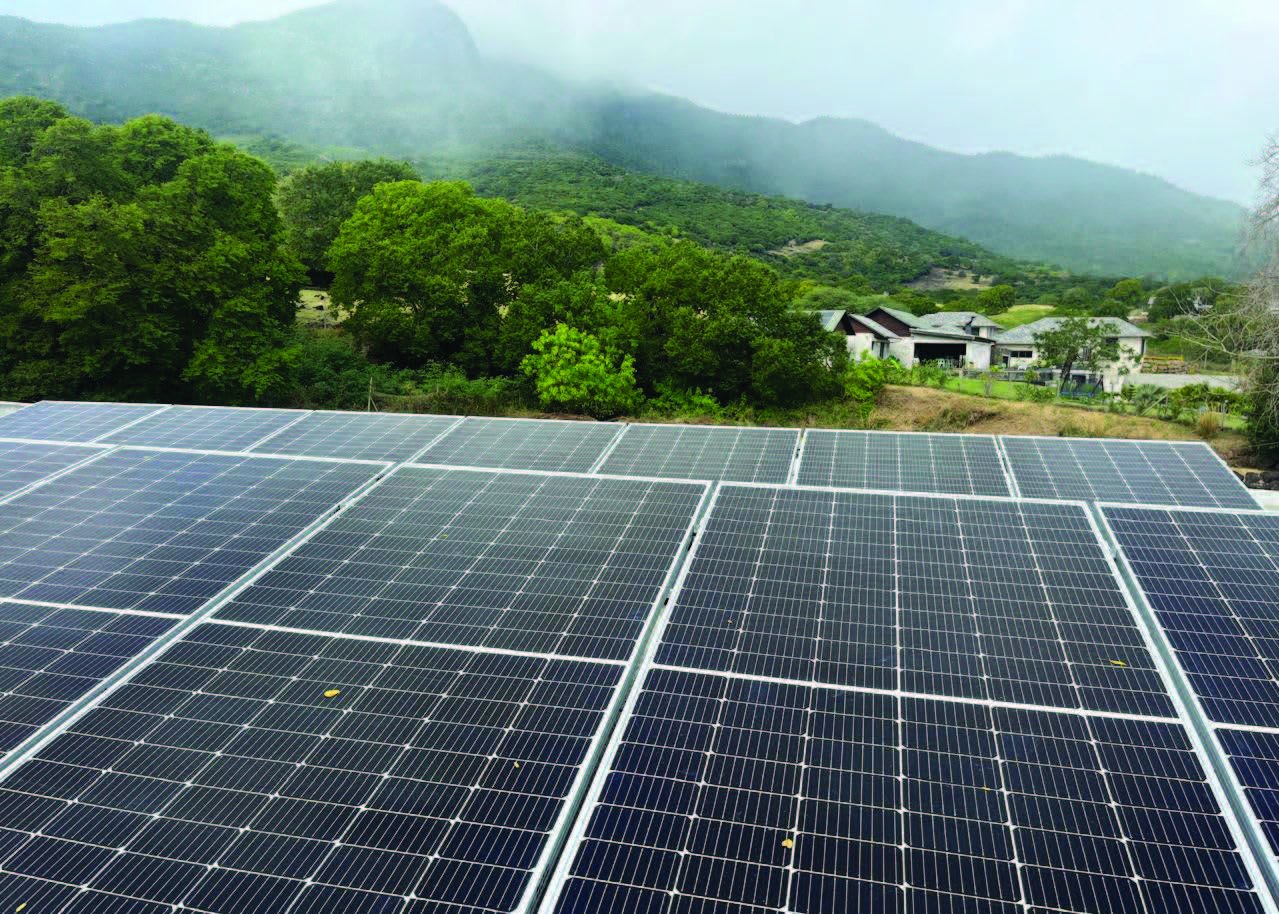
A Mauritian roof yields around 4.5 kWh per installed kWp on an average day across the year. An off-grid design cannot use that number on its own, because the average day is not the day that breaks the system.
So we work from three figures instead. The daily load, measured honestly and appliance by appliance rather than estimated from a bill that does not exist yet. The autonomy — how many consecutive low-sun days the battery must cover unaided, typically two to four. And the recovery rate — how fast the array can refill a drained battery while still running the house, which is what stops a long grey spell turning into a slow slide to zero.
Those three produce an array and a battery that are both larger than a grid-tied equivalent, and the honest way to present that is as the price of independence rather than as a bigger discount on a bill.
Load management is the other half. An off-grid house that heats water with electricity at seven in the evening needs a materially bigger system than the identical house that heats it at noon. Moving the heavy loads into the sun is the cheapest kilowatt-hour in the whole design.
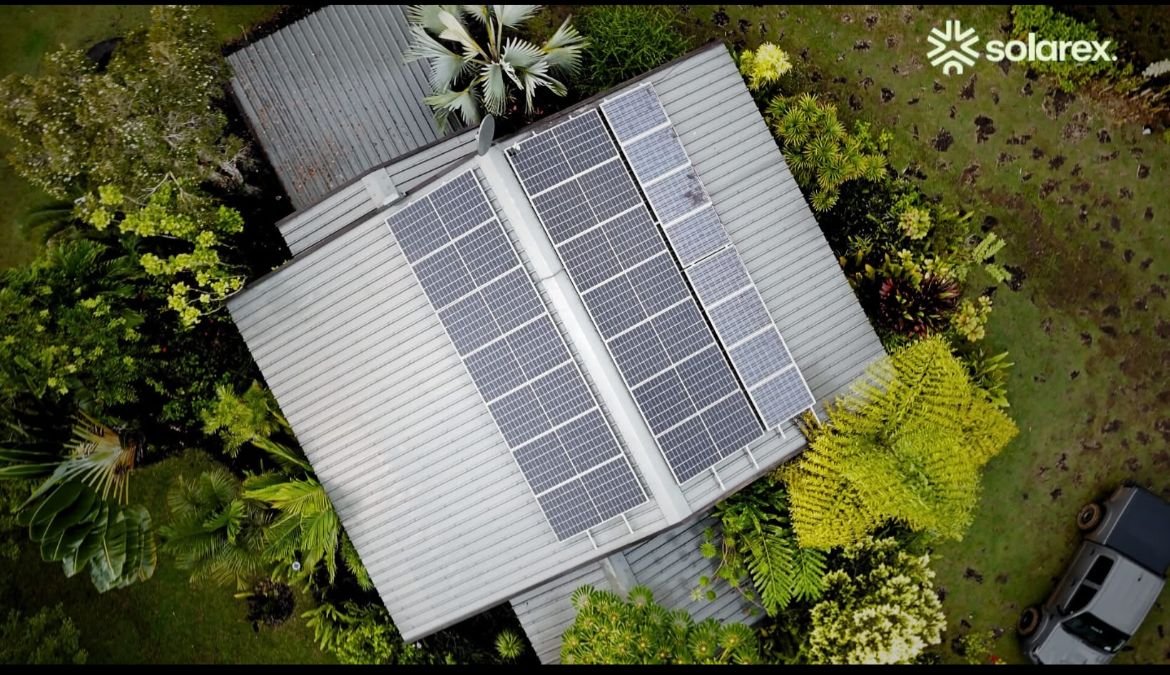
Deep in the Mauritian bush, with no CEB line worth extending, we built a chalet that has never had a utility connection. Two panel arrays on the roof, a battery bank sized for the rainy season, and a load plan agreed with the owner before a single bracket went up.
It has run through cyclone seasons since. There is no bill, no meter reading and no supply to lose — and the only maintenance the system has needed is the maintenance we scheduled.
Every appliance, its power, and the hours it runs. With no meter history to lean on, this list is the specification.
How many sunless days the system must ride out unaided. This single number moves the battery cost more than anything else.
The array has to run the house and refill the battery on a mediocre day — not just on a good one.
Full DC and AC protection, battery commissioning, and remote monitoring so performance is watched rather than assumed.
Not usually, if you already have a connection. The battery and the extra array needed to cover bad weather cost more than the grid connection they replace. Off-grid wins clearly in two cases: when there is no line to your site and extending one is expensive, and when independence from the utility is worth paying for in its own right. If your goal is simply a smaller bill, a hybrid system gets you there for less.
That is exactly the case the system is sized for. We set an autonomy target — commonly two to four days of normal consumption with negligible generation — and size the battery to meet it, then check that the array can still refill it on the mediocre days that follow. Some off-grid sites also keep a small generator as a rarely-used insurance policy, which we will happily design around if you want one.
Yes, and it is the single most expensive thing you can ask an off-grid system to do. Inverter-type units and good insulation help a great deal. The important thing is to declare it at the load-list stage rather than add it afterwards — retrofitting air conditioning onto a system sized without it is how off-grid installations end up disappointing their owners.
A system with no grid connection has no grid connection agreement to obtain, which removes one step. Normal building and electrical requirements still apply, and we handle the compliance side as part of the installation scope.
Sometimes — it depends on what was installed. A hybrid system with a generously sized array and room to expand the battery can often be converted. One sized tightly against a grid backstop usually cannot, without adding significant capacity. If full independence is a possible destination, tell us at the design stage and we will leave the door open.
Tell us about the site and what has to run on it. We will tell you honestly whether off-grid is the right answer — and what it takes if it is.