
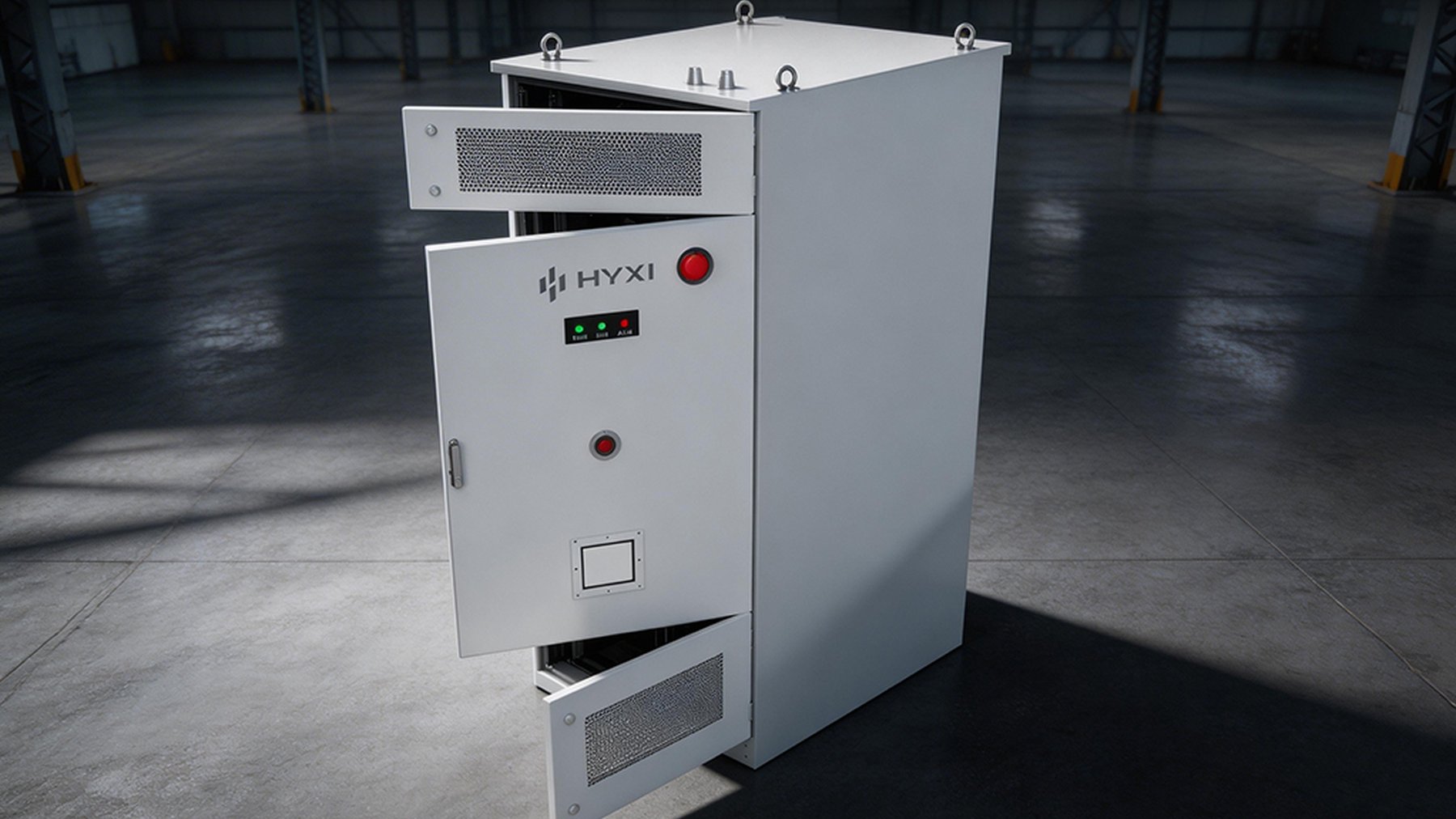
A liquid-cooled all-in-one storage cabinet: 314 Ah automotive-grade cells, a 125 kW three-phase inverter and seven layers of fire protection, in a sealed IP55 enclosure rated C5 for a coastal site.
The Atlas is not a battery you connect to something. It is 261 kWh of LFP storage, a 125 kW power conversion system, thermal management, fire protection and an energy management system, delivered as one sealed unit that arrives on a lorry and connects to your switchboard.
For a hotel, a factory or a cold store the case for it is rarely about solar. It is about a demand charge you keep paying, a diesel generator you keep testing, and a grid that is not always there — and about the fact that a battery answers all three while a generator answers one.
The conversion side is SiC-based with a three-phase four-leg structure, which is the specification that lets it hold 100 % unbalanced load. Real commercial buildings are not balanced across three phases, and an inverter that cannot cope with that is derated in practice long before it is on paper.
The demand charge on a commercial CEB account is set by your worst fifteen minutes of the month. A battery that carries the peak turns that into an ordinary quarter-hour, every month, for the life of the asset.
A diesel set costs money standing still — fuel, servicing, testing, the fuel that ages in the tank. The Atlas covers the same outages silently, with no fuel and no emissions, and it earns its keep on the days nothing goes wrong.
A factory generating 300 kW at noon and using 120 kW is exporting the difference. Storage moves that surplus into the evening shift instead of selling it back at a fraction of what you rebuy it for.
C5 anti-corrosion on the whole cabinet, IP55, and −30 to +55 °C. On this island a commercial site is usually a coastal site, and C5 is the grade that assumes salt.
Half-hourly data if your meter has it, twelve months of bills if it does not. Commercial storage is sized against peaks and their duration — the number that matters is not how much you use, it is when, and for how long the worst of it lasts.
One cabinet, 2,620 kg, craned into place on a prepared slab and connected to the switchboard at 400 V. No battery room to build, no separate inverter to house, no cell assembly on site.
Peak shaving, load shifting, backup, or zero-export with smart phase control — set against your tariff and your shift pattern, and adjusted as they change. Cells are held within 3 °C of one another by the liquid loop, which is what makes a twenty-year asset out of a ten-year one.
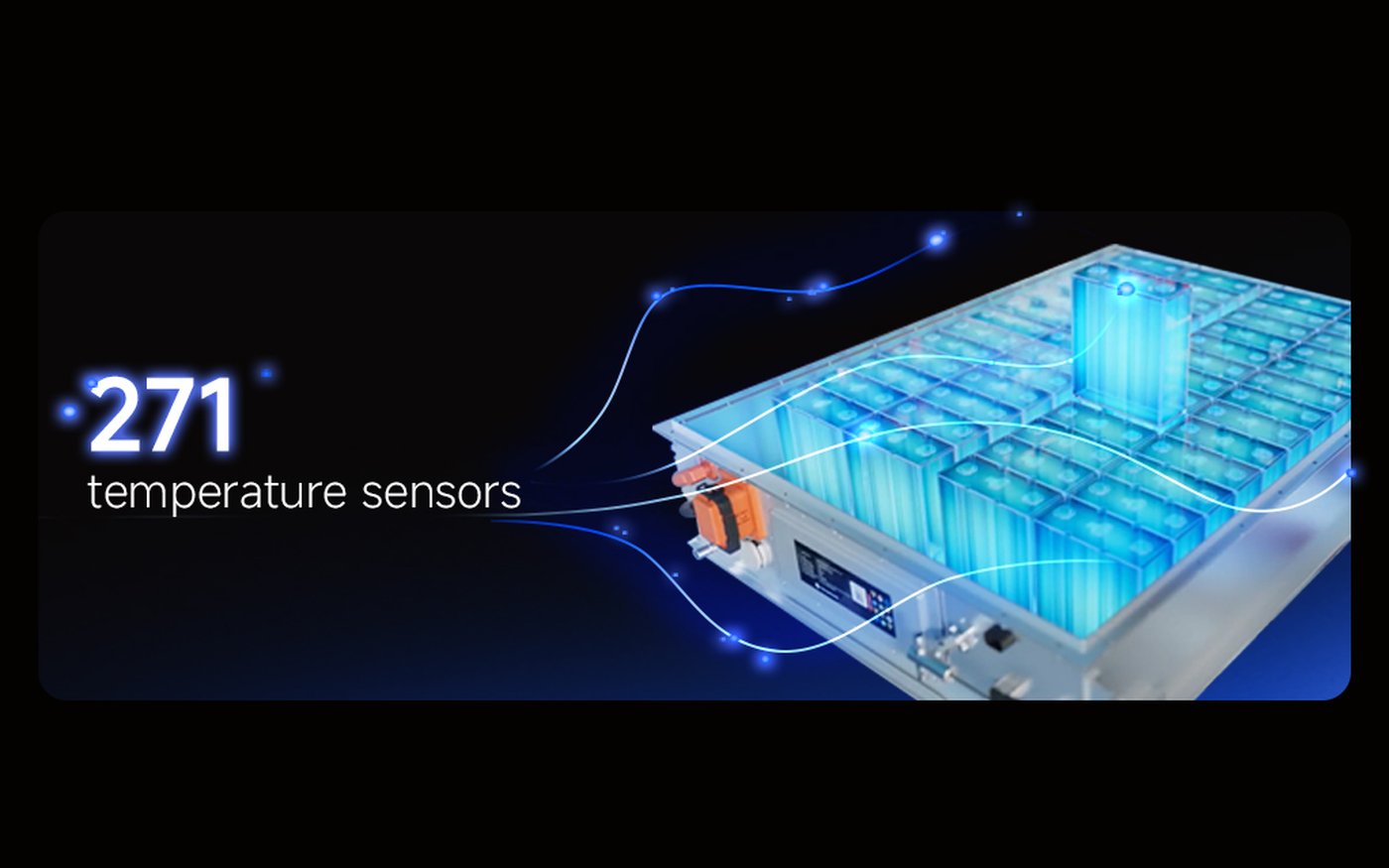
Battery life is thermal life. Cells age at the rate the hottest ones age, and in an air-cooled cabinet the difference between the middle of the stack and the edge is enough to decide the warranty.
The Atlas measures at 271 points to 0.05 °C and moves heat with liquid rather than fans, holding the whole pack within a few degrees of itself. In a Mauritian summer that is the difference between the datasheet life and something considerably shorter — and the coolant refills itself, so a year passes between service visits.
Two independent problems get two independent answers. Electrically, six layers of protection isolate an overcurrent within 20 ms — faster than a fault can propagate out of the module it started in.
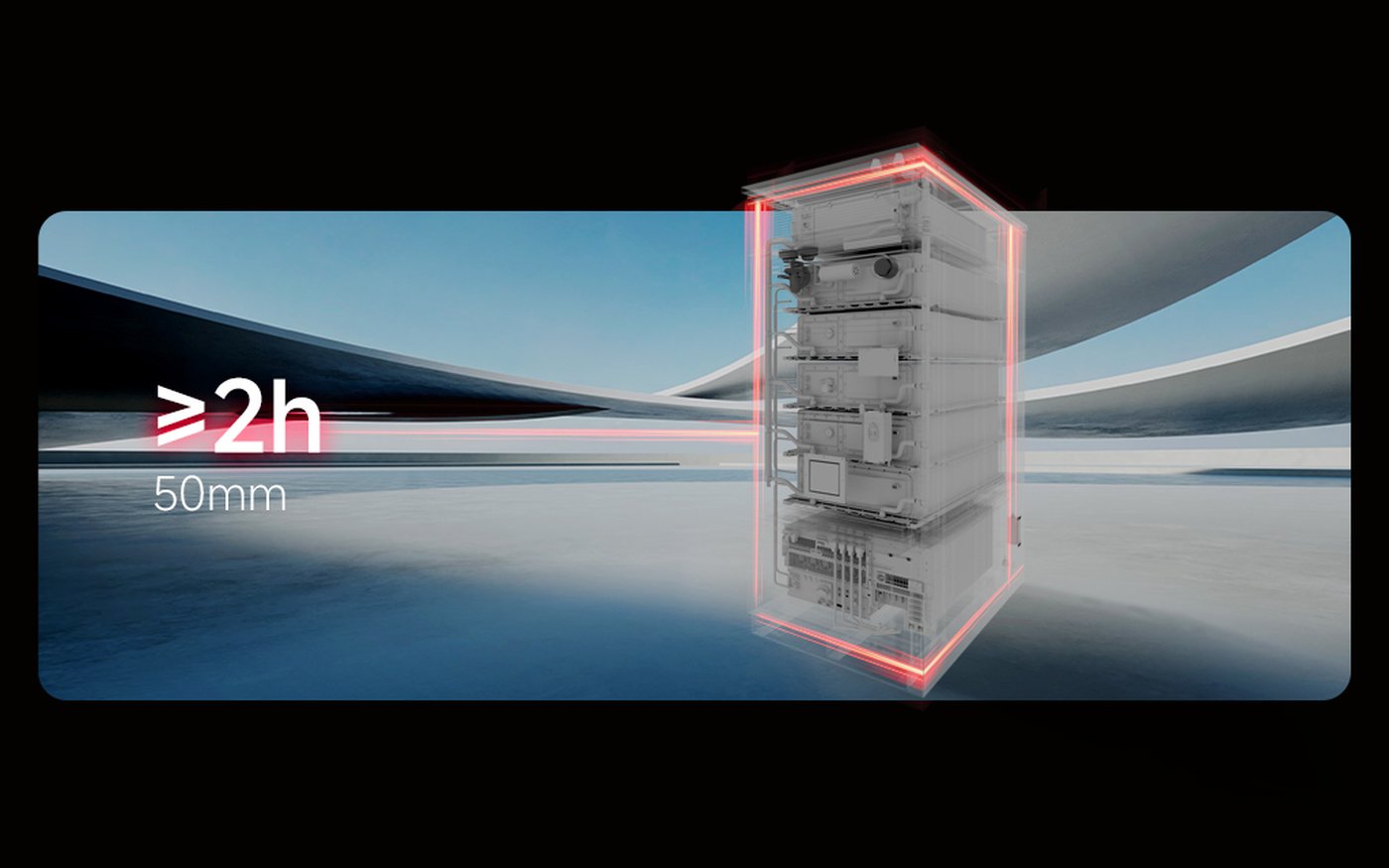
Thermally, 50 mm of A1-grade insulation rated to 1,000 °C contains a fire inside the cabinet for up to two hours. That number is not for the battery, it is for the fire brigade and for the building next to it, and it is the specification an insurer will ask about first.
Underneath both is the cell itself: LFP chemistry in an automotive-grade pack, which is the chemistry that does not have a thermal runaway problem to manage in the first place.
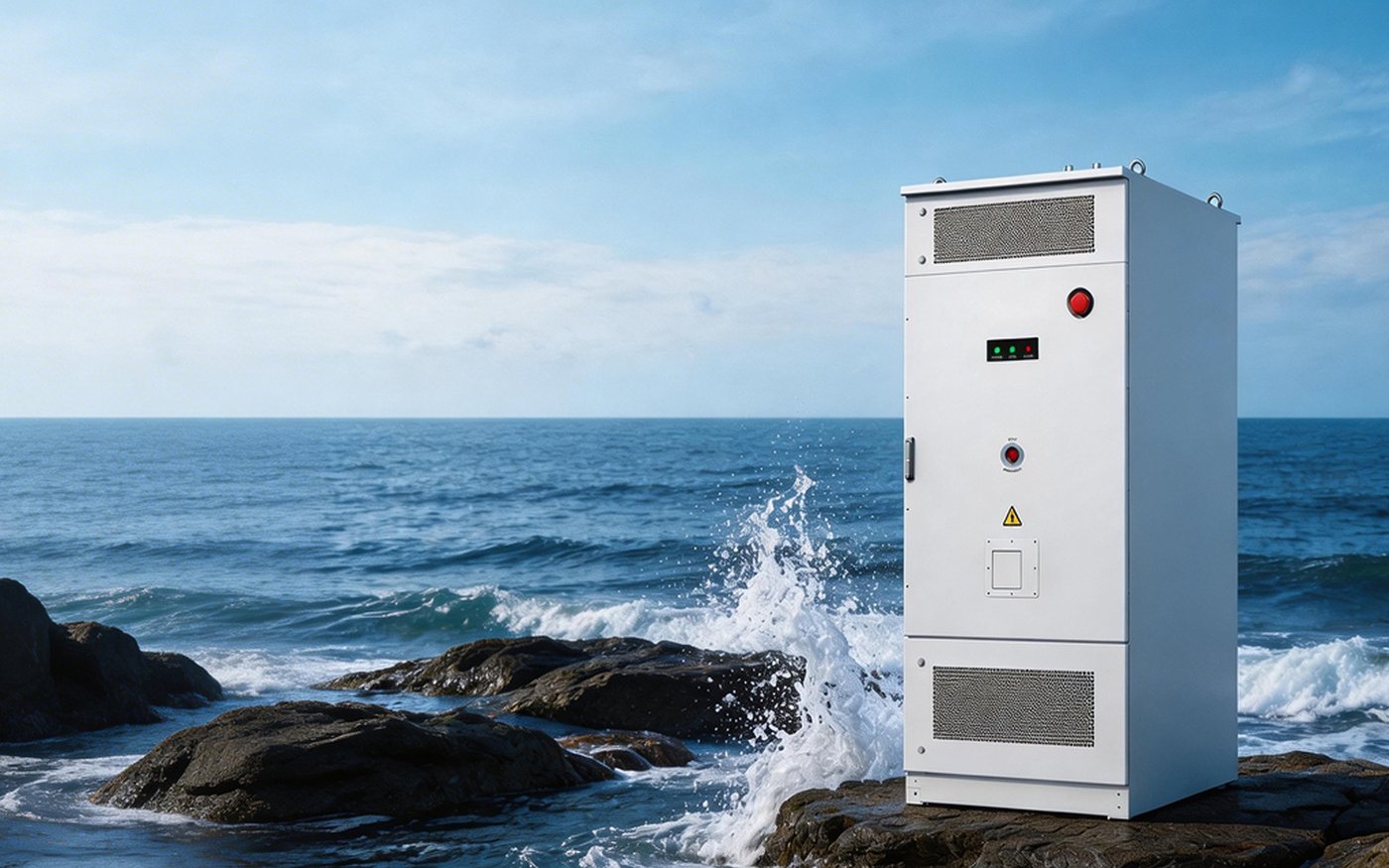
Corrosion categories run C1 to C5. C5 is the top of the scale — coastal and industrial atmospheres with high humidity and salt — and Hyxipower rate the whole cabinet, not just the shell, for over fifteen years in it.
For most of the commercial sites on this island that is not an upgrade, it is the minimum sensible specification. Between the sea and the sugar, equipment here corrodes on a schedule that surprises people who specified it from a European catalogue.
| Battery | |
|---|---|
| Cell type | LiFePO4, 314 Ah |
| Configuration | 1P260S |
| Nominal capacity | 261 kWh |
| Nominal voltage | 832 V DC |
| Operating voltage | 728 – 936 V DC |
| AC side — on-grid | |
| Nominal power | 125 kW |
| Nominal voltage | 3L / N / PE, 230 / 400 V |
| Nominal current | 180 A |
| Frequency | 50 / 60 Hz ± 2.5 Hz |
| THD of current | < 3 % at nominal power |
| Power factor | 0.99 leading – 0.99 lagging |
| AC side — off-grid | |
| Nominal power | 125 kW |
| Nominal voltage | 3L / N / PE, 230 / 400 V |
| Unbalanced load capacity | 100 % |
| THD of voltage | < 3 % on linear load |
| Safety and thermal | |
| Fire protection | 7-layer design, 50 mm A1-grade insulation, up to 2 hours |
| Electrical protection | 6 layers, 20 ms cut-off |
| Thermal monitoring | 271 points, 0.05 °C resolution |
| Cooling | Liquid, with automatic refill |
| Physical and environmental | |
| Dimensions (W × H × D) | 1,000 × 2,402 × 1,467 mm |
| Weight | 2,620 kg |
| Ingress protection | IP55 |
| Anti-corrosion | C5 |
| Operating temperature | −30 to +55 °C (PCS derates above 50 °C) |
| Operating humidity | 0 – 100 % |
| Altitude | 3,000 m |
| Module replacement | 10 minutes |
Figures are from the Hyxipower HYX-EL261P2-EU datasheet V1.5 and are subject to change without notice.
From your demand charge and your load curve, not from the capacity. The calculation is the peak you can shave, multiplied by the tariff, plus whatever a generator currently costs you to own. We do it against your own readings before quoting, and we have told people it does not pay — which is the answer worth having.
No. Peak shaving and backup both work on grid charging alone, and plenty of commercial cases stand up without a single panel. Solar changes the arithmetic favourably where there is roof to use, but it is a separate decision.
A prepared slab, crane access, and a connection to your switchboard. It is 2,620 kg and arrives complete — there is no battery room to build and no cells to assemble on site. We handle the CEB process for a grid-connected installation of this size.
Capacity fades, which is why the EMS is sized with headroom and why the liquid loop matters: keeping the pack within a few degrees of itself is the single biggest lever on how fast that happens. Modules are individually replaceable in about ten minutes, so the cabinet does not have an end-of-life event.
For a while, and that is a design decision rather than a product one. 125 kW and 261 kWh is roughly two hours at full output, longer at a realistic load, and it holds 100 % unbalanced load — which real buildings are. We model the outage you actually want covered.
Half-hourly data if you have it. We will model what a 261 kWh cabinet would take off your peaks and what that is worth against your tariff — and tell you if the answer is no.
Request a quote