
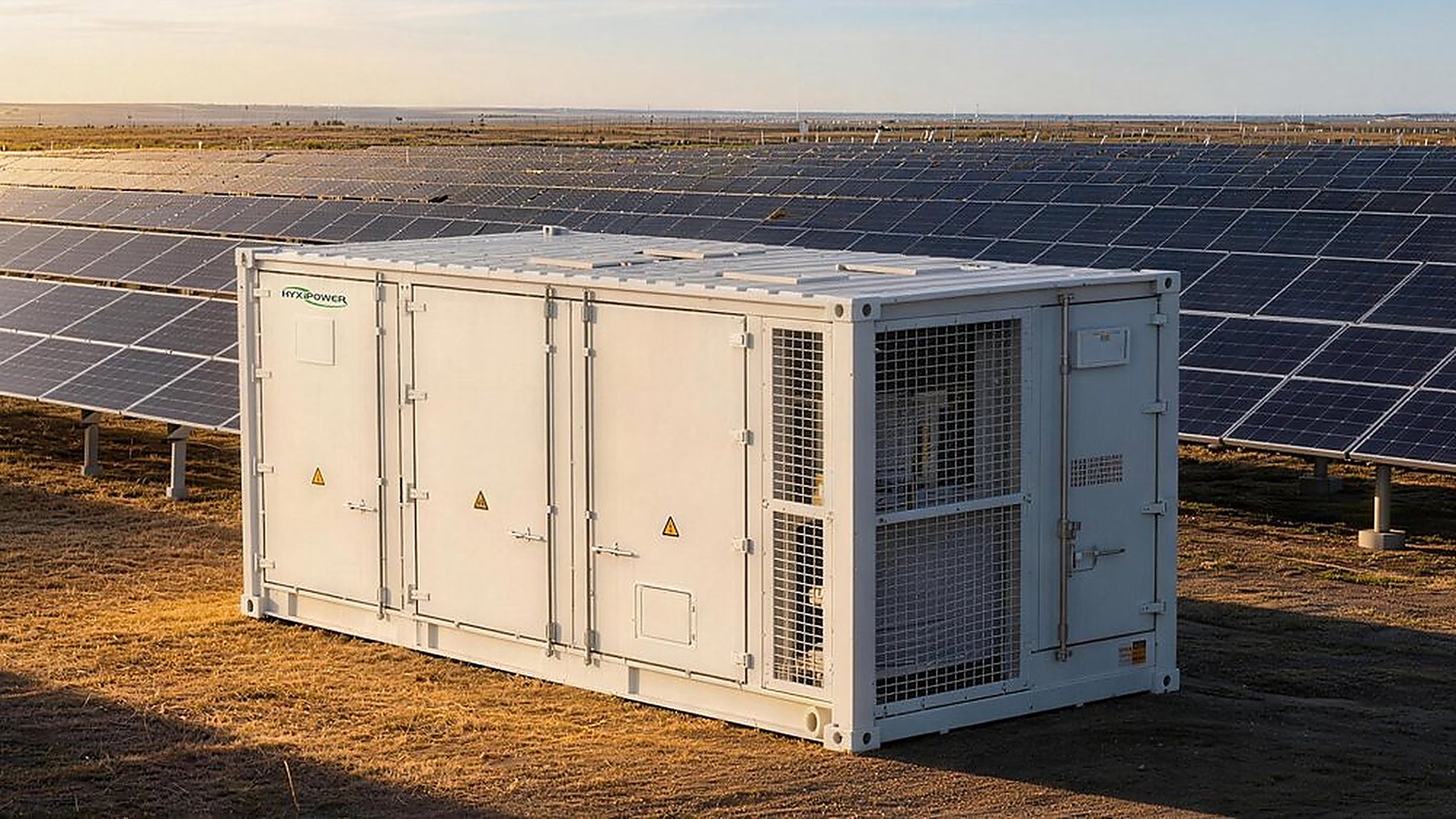
Utility-scale storage delivered as a sealed liquid-cooled container: 3.34, 4.18 or 5.01 MWh of LFP, six-sided flame retardancy, aerosol and water suppression, and round-trip efficiency above 90 % after its own consumption.
The Atlas Mega is a containerised battery energy storage system — a standard 20-foot footprint holding up to 5.01 MWh of 314 Ah LFP cells at 1,331 V, with liquid cooling, fire suppression and monitoring built in. It ships as one unit and commissions as one unit.
At this scale the buyer is not a building, it is a grid. Independent power producers firming a solar farm, industrial sites with megawatt loads, and utilities that need to move energy from a sunny afternoon into an evening peak — the same problem the CEB is solving as renewable penetration rises on an island grid with no interconnector.
That last point is the whole argument for storage in Mauritius. A grid that cannot import a single kilowatt from a neighbour has to balance itself, and every megawatt-hour of storage on it is a megawatt-hour of solar that becomes dispatchable instead of merely available.
A PV plant without storage sells what the weather decides. With it, output becomes something you can commit to in a power purchase agreement — which is usually the difference between a project that finances and one that does not.
Mauritius has no interconnector. Every megawatt of variable generation has to be balanced locally, and fast storage does frequency response in milliseconds where a thermal set takes minutes.
Textile, sugar, cold chain, water treatment. Where the demand charge is measured in hundreds of kilowatts, peak shaving stops being an efficiency measure and becomes a line on the P&L.
The island generates most of its solar between ten and three and uses most of its power between six and ten. Storage at this scale is the bridge across those hours.
Grid connection studies, a site survey, the tariff and dispatch model, and the CEB process. A project at this scale lives or dies on the connection agreement and the revenue model, and both are settled long before anything is ordered.
6,058 × 2,896 × 2,438 mm, 33 to 43 tonnes depending on capacity. A prepared foundation, a crane, and a medium-voltage connection. Everything inside — cells, cooling, suppression, controls — is factory-assembled and tested.
The iEMS runs the strategy and reports to a cloud that can hold several sites at once, with AI fault prediction on the cells. This is a twenty-year asset with a duty cycle, and the operating discipline matters as much as the hardware.
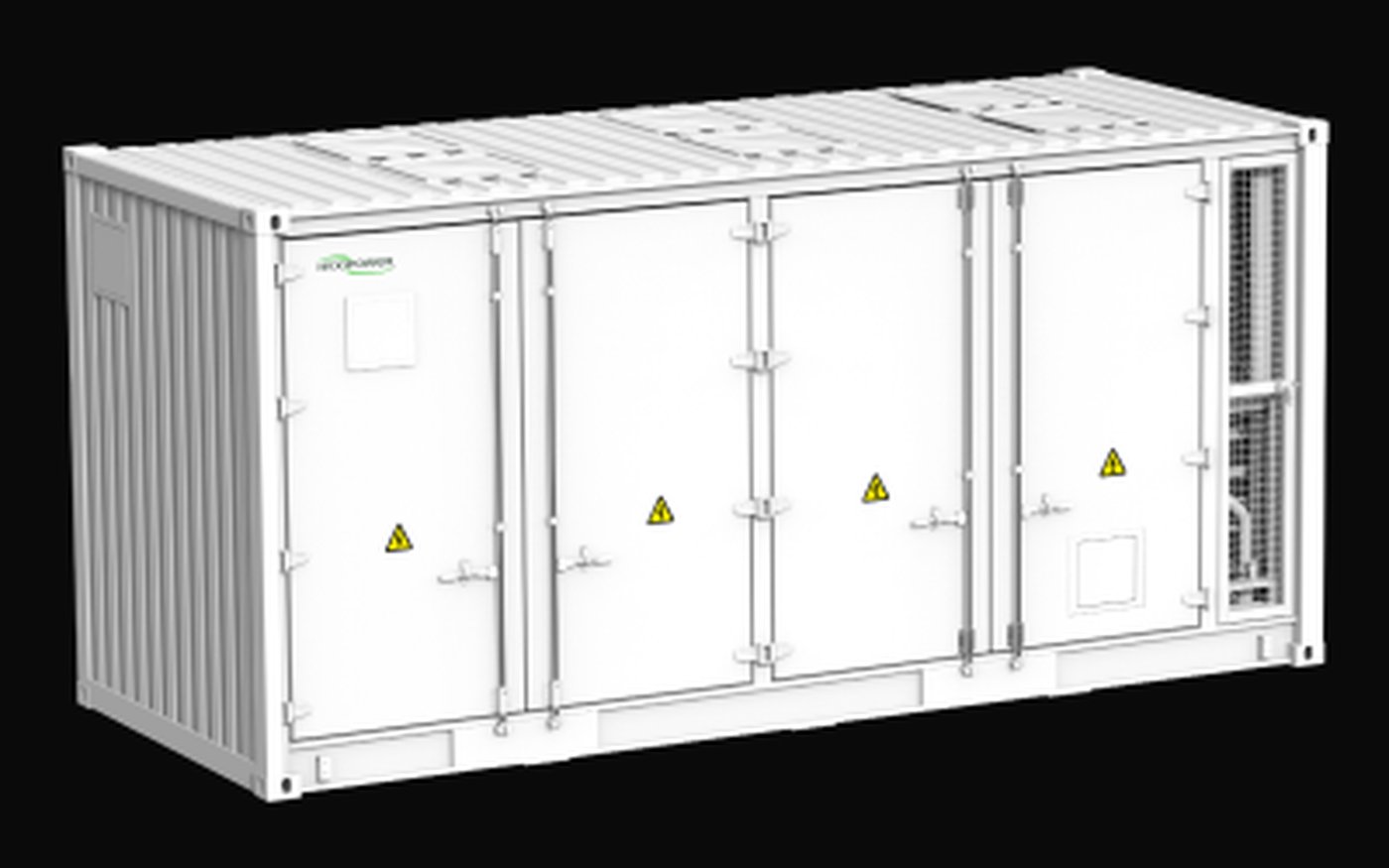
A megawatt-hour-scale battery is a serious object and the safety case has to be made in layers. The enclosure is flame-retardant on all six sides; suppression is both aerosol and water; and the monitoring system is designed to give warning before either is needed rather than after.
Thermally, the liquid loop holds cells within 3 °C of one another — the same principle as the Atlas cabinet, at fifteen times the scale. Cell-level AI fault prediction watches for the drift that precedes a failure, which is the only intervention that is genuinely cheap.
Round-trip efficiency is stated at ≥ 90 % including the system’s own consumption, which is the honest way to quote it: cooling and controls draw power, and an efficiency figure that excludes them is a figure you cannot bank.
| Battery | |
|---|---|
| Cell type | LiFePO4, 314 Ah |
| Configuration | 8P416S / 10P416S / 12P416S |
| Nominal capacity | 3.34 / 4.18 / 5.01 MWh |
| Nominal voltage | 1,331.2 V |
| Operating voltage range | 1,164.8 – 1,497.6 V |
| Charge / discharge rate | ≤ 0.5 C |
| Performance | |
| Max. efficiency | ≥ 90 %, including self-consumption |
| Protection | Over-voltage, over-current, short circuit, over-temperature, emergency stop |
| Physical and environmental | |
| Dimensions (W × H × D) | 6,058 × 2,896 × 2,438 mm |
| Weight | 33 / 38 / 43 tonnes |
| Ingress protection | IP55 |
| Anti-corrosion | C3 / C4 / C5, optional |
| Operating temperature | −30 to +55 °C |
| Storage temperature | −20 to +35 °C |
| Operating humidity | 0 – 95 % |
| Altitude | ≤ 2,000 m |
| Noise | ≤ 80 dB |
| Cooling | Liquid |
| Fire protection | Aerosol and water suppression |
| Networking | LAN, RS485, CAN |
Figures are from the Hyxipower HYX-EL(3000-5000)P2-DC datasheet V1.1 (preliminary) and are subject to change without notice.
Yes, and it is already happening — the CEB has been procuring grid-scale storage as renewable penetration rises, because an island grid with no interconnector has to balance itself. The projects that make sense here are IPP solar farms needing firm output, and large industrial sites with a demand charge worth attacking.
A grid connection study, a site with crane access and a foundation, a medium-voltage connection, and an agreement with the CEB that settles how the asset is allowed to operate and how it is paid. The hardware is the straightforward part; the connection and the revenue model are where the timeline goes.
Because cell life is thermal life and this is a twenty-year asset. Holding every cell within 3 °C of its neighbours is not achievable with air at this density, and the difference compounds: a pack that runs a few degrees hotter does not fail, it just reaches its end-of-warranty capacity years earlier than the model said.
It is the energy you get out divided by the energy you put in, and it decides the economics of every cycle. The ≥ 90 % here is quoted including the system’s own consumption — the cooling and the controls — which is the number that actually reaches your meter. Figures quoted excluding auxiliaries look better and are not bankable.
Yes — these are designed to be deployed in multiples, with an EMS that manages a site and a cloud layer that manages several sites. Capacity scales by adding containers rather than by redesigning anything.
Grid-scale storage starts with a connection study and a dispatch model, not a datasheet. Tell us the site, the load or the generation you are firming, and we will tell you whether it stands up.
Request a quote