
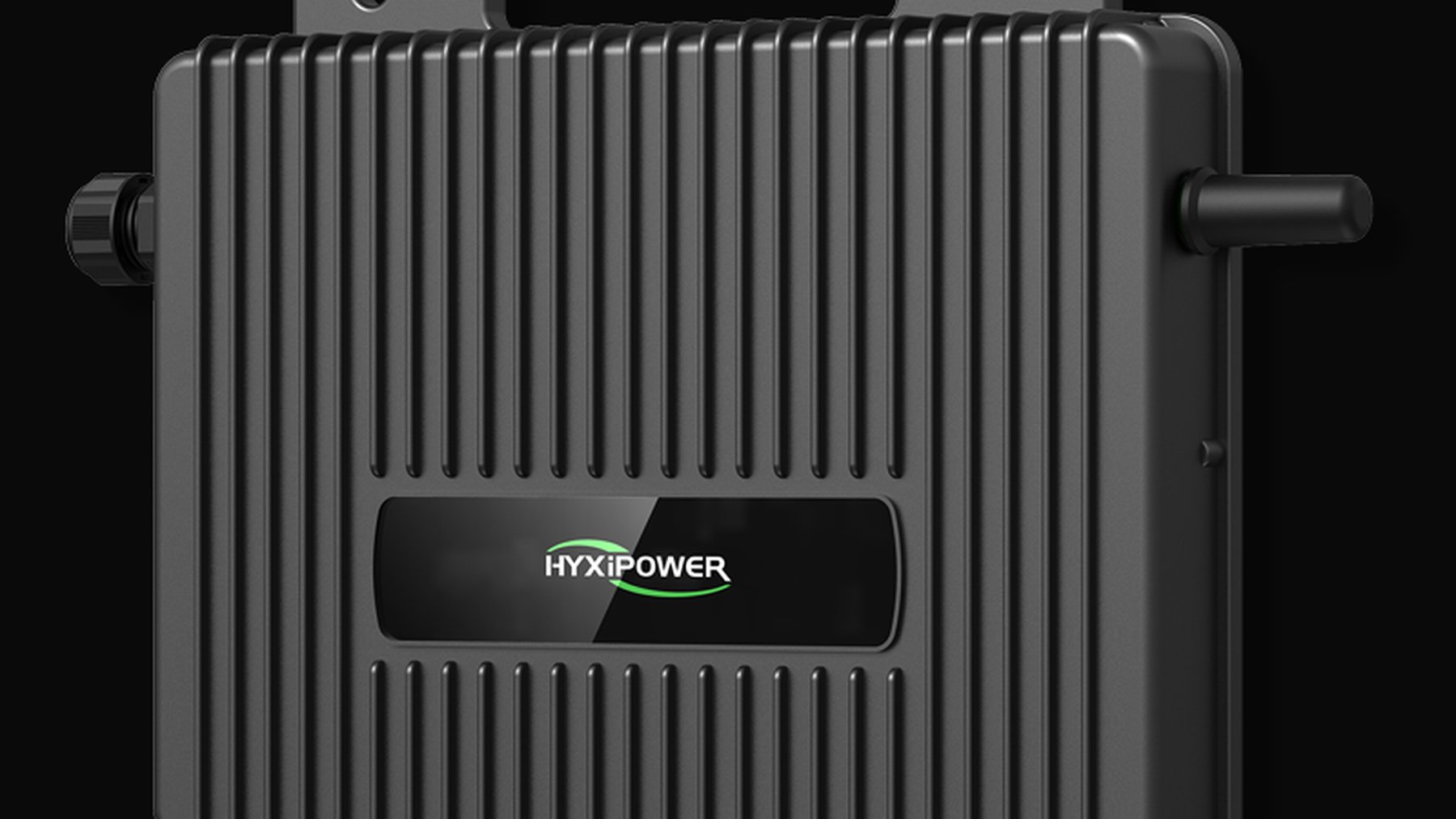
A microinverter converts at the panel instead of at the wall. Each module finds its own maximum power point, so a tree, a chimney or an afternoon shadow costs you that panel and not the string it sits in — and nothing on your roof ever carries high-voltage DC.
A conventional system wires panels in series into a string, and a string is only as good as its weakest module. Shade one panel and the whole string drops to what that panel can manage. On a Mauritian roof — trees, water tanks, neighbouring walls, a hill that takes the sun at four o’clock — that is not a corner case, it is Tuesday.
A microinverter is a small inverter bolted under the panel itself. The HYXI 2-in-1 serves two modules with independent MPPT tracking on each, converts to 230 V AC on the spot, and hands the roof nothing more dangerous than mains. Peak efficiency is 96.7 % and MPPT tracking efficiency is 99.8 %.
The range runs from 300 W single-module units up to a 2,500 W four-module unit, so it scales from a two-panel balcony to a full roof. The 600–1,000 W 2-in-1 documented below is the one most Mauritian houses end up with.
Trees, a water tank, a chimney, a taller neighbour. Anywhere part of the array is shaded part of the day, per-panel conversion recovers what a string would lose.
A hipped roof facing three ways cannot be one string. Microinverters make orientation a per-panel question instead of a design constraint, so awkward roofs stop being expensive roofs.
Add two panels, add a microinverter. There is no string to rebalance and no central inverter to outgrow — the system extends in units of two modules for as long as the roof lasts.
No high-voltage DC anywhere in the array: conversion happens at the module and everything above the roofline is 230 V AC with a built-in relay that can physically disconnect.
Each microinverter hooks to the rail under a pair of modules. Two independent MPPT trackers, up to 16 A each, sized for modules from roughly 320 W to 600 W and beyond depending on the model.
The units connect to each other and run back on one AC branch — up to eight 800 W units on a single 10 AWG branch. That is the entire roof wiring: no DC isolators, no string combiner, no fuses.
The commissioning app scans the array and builds the layout automatically instead of somebody typing serial numbers on a roof. After that you have per-panel monitoring for the life of the system — a bad module shows up as a module, not as a system that is quietly down 8 %.
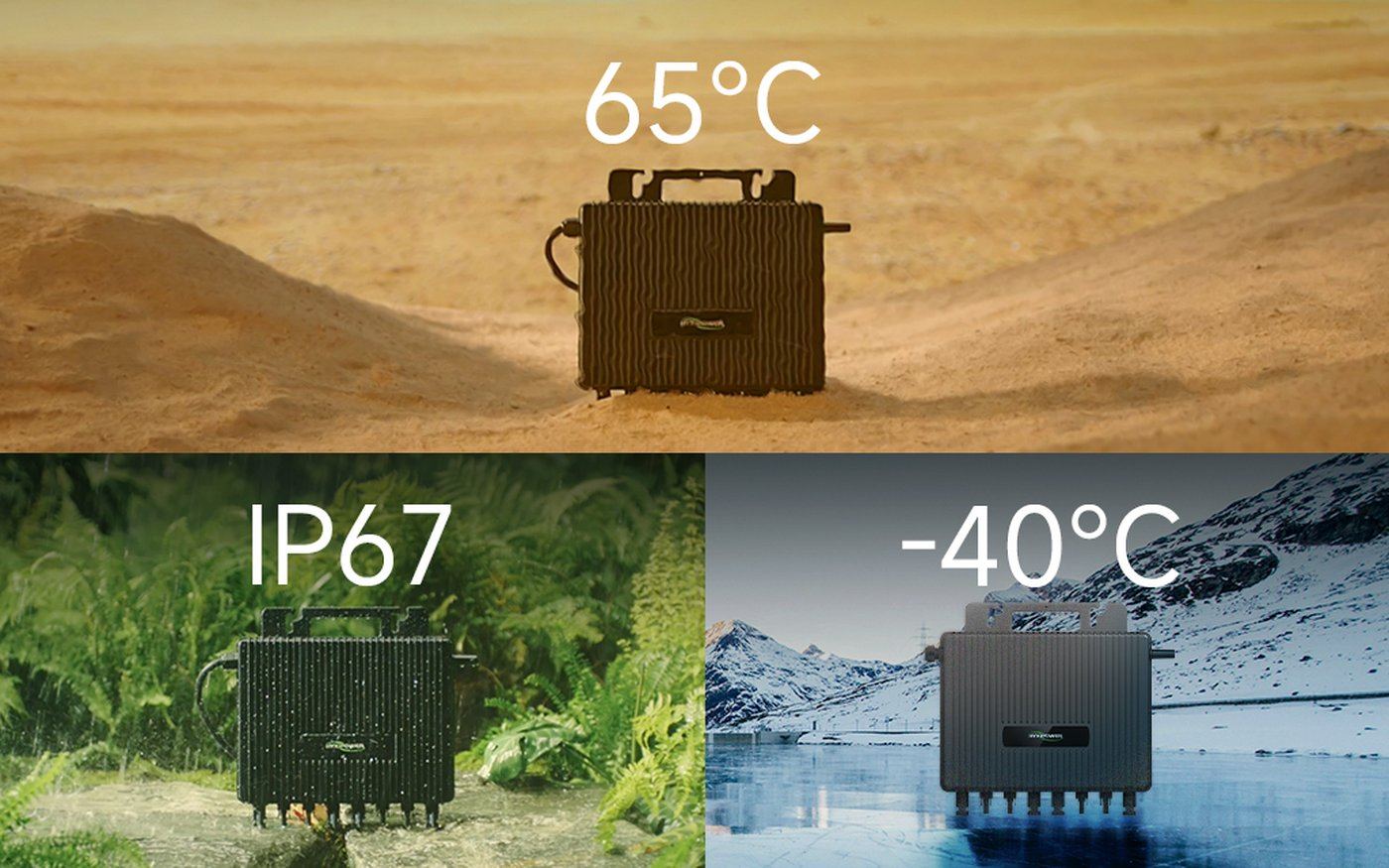
A microinverter lives where the panel lives: full sun, all day, every day. A roof surface in Mauritius in February is a genuinely hostile place for electronics, and plenty of hardware quietly reduces its output rather than fail visibly.
These are rated to +65 °C with no load reduction and validated over 72 hours of high-temperature testing. IP67 means sealed against dust and temporary immersion — which on a roof means driving rain from the side, and it means salt air on a coastal site.
They are cooled by nothing at all: no fan, no vent, no filter. The failure modes that come with moving parts simply do not exist here.
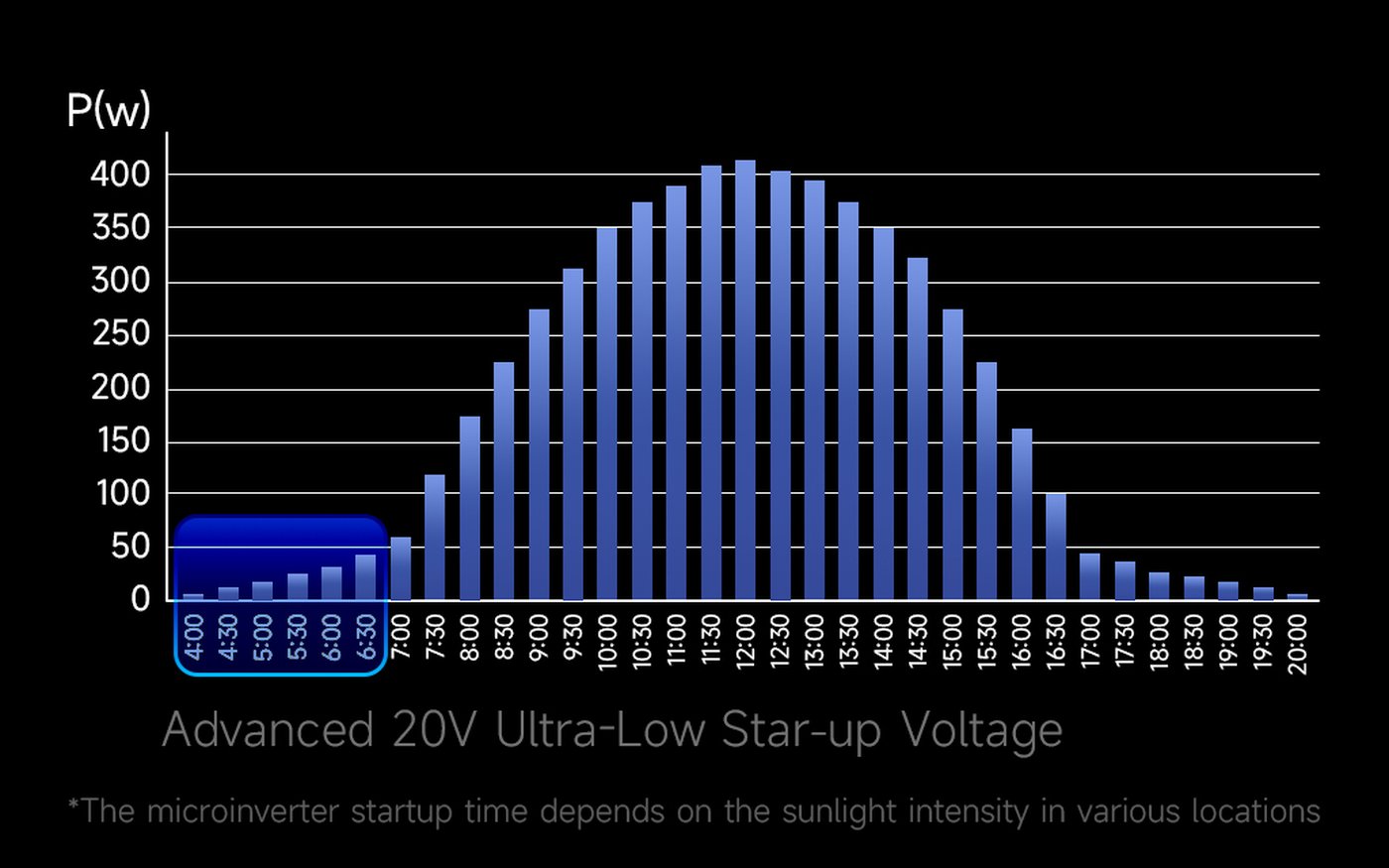
A 20 V start-up voltage means the unit begins converting very early and keeps going very late — the first and last light of the day, which a higher-threshold inverter simply sits out.
It sounds marginal and it is not. The shoulders of a tropical day are long, and over a year the accumulated early-morning and late-afternoon generation is real energy on a bill. The unit also carries 150 % overload capacity, so a bifacial module having a very good moment is not clipped.
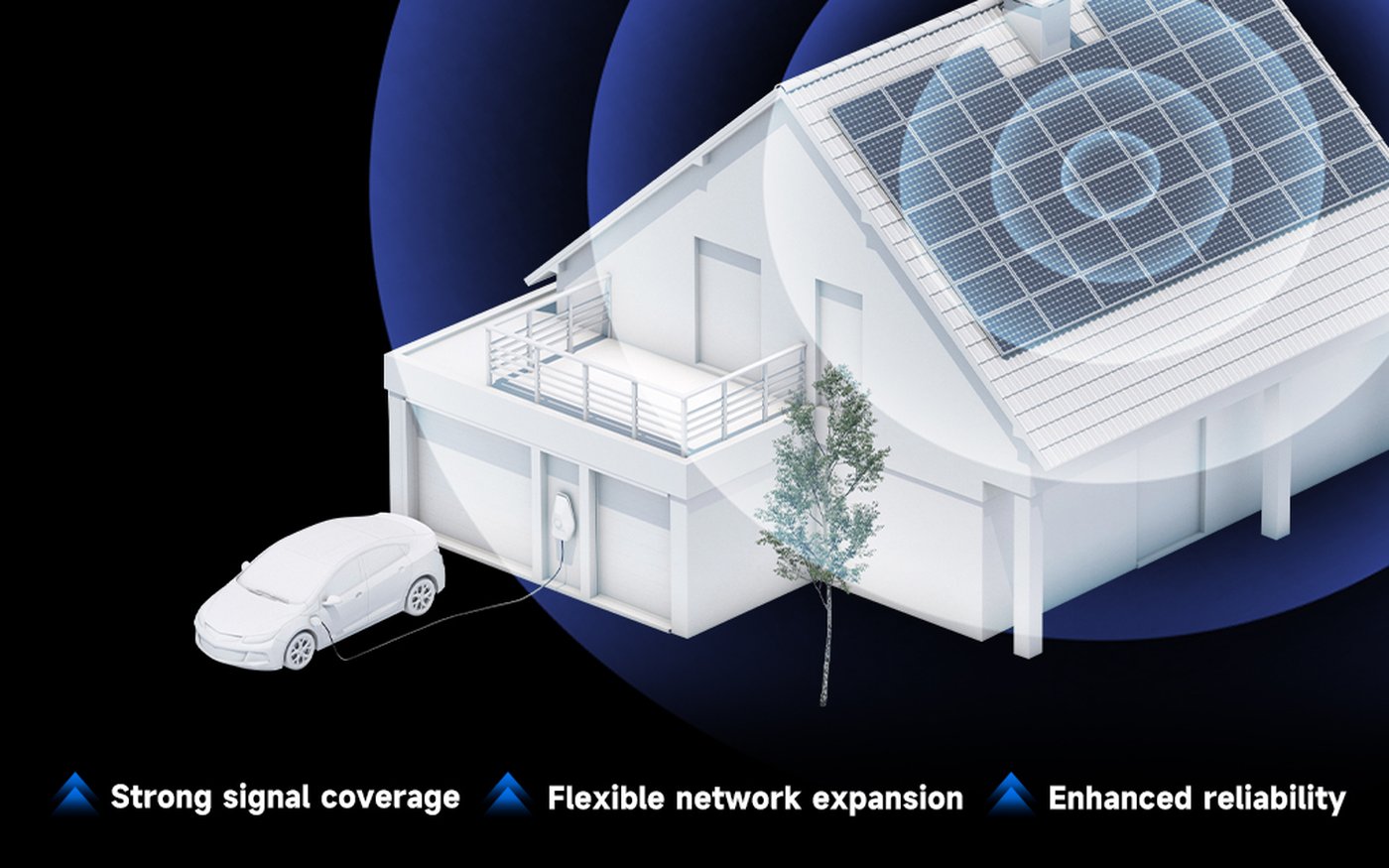
The units talk over Sub-1 GHz radio in a mesh — a band that goes through walls and concrete far better than Wi-Fi, with a range measured in hundreds of metres. Each unit relays for its neighbours, so a roof does not depend on one node reaching the router.
What that buys you is per-panel visibility. A string system tells you the array is down; this tells you which module, which is the difference between a diagnostic visit and a repair. Faults raise an alarm, firmware updates go out over the air, and the warranty is 12 years as standard with 25 available.
| Input (DC) | |
|---|---|
| Typical module compatibility | 240 – 670 W per input, by model |
| MPPT voltage range | 16 – 60 V |
| Max. input voltage | 65 V |
| Start-up voltage | 20 V |
| Max. input current | 2 × 16 A |
| Max. short-circuit current | 2 × 20 A |
| MPP trackers | Two, independent |
| Output (AC) | |
| Nominal output power | 600 / 700 / 800 / 900 / 1,000 VA |
| Nominal output voltage | 220 / 230 / 240 V |
| Adjustable voltage range | 183 – 276 V |
| Nominal frequency | 50 / 60 Hz |
| Power factor | > 0.99 default, 0.8 lead – 0.8 lag adjustable |
| THDi | < 3 % |
| Max. units per 10 AWG branch | 6 – 11, by model |
| Efficiency | |
| Peak efficiency | 96.70 % |
| Nominal MPPT efficiency | 99.80 % |
| Night-time power loss | < 30 mW |
| Physical and environmental | |
| Dimensions (W × H × D) | 252 × 180 × 35 mm |
| Weight | 3 kg |
| Ingress protection | IP67 |
| Operating temperature | −40 to +65 °C |
| Cooling | Natural convection — no fans |
| Communication | Sub-1 GHz mesh / built-in Wi-Fi |
| Isolation | High-frequency transformer, galvanically isolated |
| Standards and warranty | |
| Warranty | 12 years standard, 25 years optional |
| Models | HYX-M600 / 700 / 800 / 900 / 1000-S and -SW |
Figures are from the Hyxipower HYX-M(600-1000)-S(SW) datasheet V1.0 and are subject to change without notice. The wider family runs from 300 W single-module units to a 2,500 W four-module unit; ask us for the sheet that matches your panels.
Not universally, and anyone who says so is selling. On a clean rectangular roof facing one way with no shade, a string inverter is cheaper and just as good. Microinverters earn their premium on shaded, multi-orientation or awkward roofs, and on any roof where per-panel monitoring and no rooftop DC matter to you. We quote whichever is right and explain which one we think you have.
You lose two panels, not the array. The other units keep converting, monitoring tells you exactly which one stopped, and replacing it is a single component swap under warranty rather than a system-down event. With a string inverter, a failure is the whole system.
Yes, on the AC side — a microinverter array pairs with an AC-coupled battery like the Halo 5 rather than with a hybrid inverter’s DC bus. If storage is central to your plan from the start, a hybrid inverter and a DC-coupled battery is often the cheaper route; if you already have microinverters, AC coupling is the answer.
They are rated to +65 °C with no derating, sealed to IP67 and have no fan. The warranty is 12 years as standard, with 25 available — which for a component sitting in full sun is the number worth comparing against anything else you are quoted.
Not with this model — the 2-in-1 serves two modules with a separate tracker for each, so shading is still handled panel by panel while the hardware count halves. There are 1-in-1 and 4-in-1 units in the range for arrays where that maths works out differently.
Genuinely — a photo and a rough idea of when the shade falls tells us more than a form does. We will tell you whether microinverters are worth their premium on your roof, or whether a string inverter does the same job for less.
Request a quote